


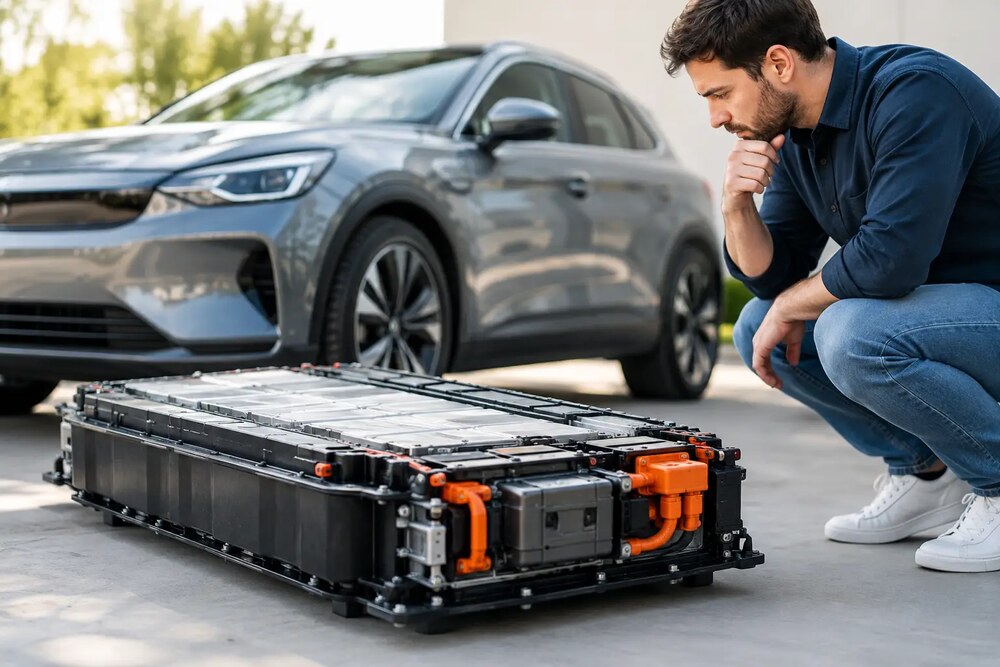
A used EV can be a smart way to reduce fuel costs without paying new-car prices. But the battery is the part that most directly affects its range, resale value and long-term usability. This electric vehicle battery guide explains what Australian buyers should check before making an offer, without assuming you need to be an electrical engineer.
Unlike an engine with a visible service history of oil changes and belts, a traction battery’s condition is less obvious. The odometer matters, but age, charging habits, climate and model-specific battery design can matter just as much. The aim is not to find a battery with zero degradation - that is unrealistic - but to understand whether the vehicle’s condition, price and remaining warranty stack up.
What an EV battery does
The high-voltage traction battery stores the energy that drives the electric motor. It is separate from the conventional 12-volt battery that powers accessories such as lights, locks and infotainment. Most modern EVs use lithium-ion battery packs, managed by a battery management system that monitors temperature, charging and cell performance.
Battery capacity is measured in kilowatt-hours (kWh). A larger usable capacity generally supports more driving range, although vehicle weight, aerodynamics, tyres, weather and driving speed all influence the result. Two EVs with the same advertised range can deliver very different real-world outcomes on a Sydney motorway, a hilly Melbourne commute or a regional road trip.
Over time, every battery loses some capacity. This is called degradation. It is usually gradual, and it does not mean the car is about to stop working. The key question for a used buyer is how much usable capacity remains and whether that meets your normal driving needs.
Battery health: the number worth checking
Battery health is often expressed as State of Health, or SOH. Put simply, it compares the battery’s current usable capacity with its capacity when new. A battery at 90 per cent SOH may still be an excellent prospect, particularly if the price reflects the car’s age and kilometres.
There is no single pass-or-fail percentage for every used EV. A small city EV with modest original range may feel restrictive after degradation, while a larger-battery SUV with the same percentage can remain practical for years. Start with your own use: daily kilometres, access to charging, typical passengers and how often you take longer trips.
Ask the seller for a recent battery health report where available. Some manufacturers provide battery diagnostics through their service network or vehicle apps. Independent EV specialists can also perform a battery assessment, although the method and detail can vary. A dashboard range figure is useful, but it is not the same as a formal health report because it changes with recent driving and conditions.
If a seller cannot provide a report, arrange an inspection with a qualified technician familiar with EVs before you commit. Treat vague assurances such as “the range seems fine” as a prompt for more checking, not proof of condition.
What affects battery degradation?
Age and kilometres both play a role, but the relationship is not perfectly linear. Batteries often lose a little capacity early, then settle into slower degradation. Frequent exposure to very high heat, long periods sitting at full charge, repeated deep discharge and heavy use of rapid DC charging can add stress over time.
That does not mean you should automatically avoid an EV that has used fast chargers. For many owners, public rapid charging is necessary and expected. Instead, look at the whole ownership story. An EV regularly charged overnight at home, serviced on schedule and driven predictable distances may present lower risk than one with unclear history, regardless of its odometer reading.
Range: compare the real-world number
Published range figures are useful for comparing models, but they are measured under set test conditions. In everyday Australian driving, range can drop when running air conditioning in summer, using heating in colder areas, carrying a full family load or travelling at sustained highway speeds.
During an inspection, check the estimated range at the current battery charge and ask how the seller normally drives the car. Then compare it with independent owner experiences for that specific model, battery size and year. A short test drive will not prove total range, but it can reveal warning lights, unusual power limits, charging faults or an unexpectedly low estimate.
For a commuter travelling 40 kilometres a day with home charging, an EV with reduced range may still offer excellent value. For someone in an apartment without reliable charging or a driver who regularly travels between regional towns, more remaining range and dependable rapid-charging capability can be worth paying for.
Check the battery warranty carefully
Most EV manufacturers provide a separate high-voltage battery warranty, commonly around eight years with a kilometre limit. The terms differ by make, model and build year. Many warranties guarantee that capacity will not fall below a specified threshold, often around 70 per cent, within the warranty period.
Check the original warranty start date, kilometre limit, transfer conditions and exclusions. Ask whether servicing had to be completed through authorised channels, and whether any battery-related repairs or recalls have already occurred. If the car was first registered overseas before coming to Australia, warranty coverage may be different or may not transfer at all.
A remaining battery warranty is valuable, but it is not a substitute for inspection. It generally covers a defined defect or capacity threshold, not every concern a buyer may have about reduced range.
Charging equipment and charging habits
A used EV should come with the charging equipment promised in the listing. Confirm whether the sale includes a portable charging cable, any adaptors, and a home wall charger if one is advertised. Check that cables are undamaged, connectors lock properly and the charge port door operates as it should.
Australia uses different public charging connector standards depending on the vehicle and its origin. Confirm the car’s AC and DC charging ports, maximum charging speeds and compatibility with the networks you expect to use. This is particularly relevant for imported vehicles, where plug type, navigation features, software support and charging access may differ from locally delivered models.
At a practical level, home charging is often the simplest and lowest-cost option. If you rent, live in a unit or park on the street, investigate your charging plan before buying. Public charging can work well, but convenience depends heavily on your suburb, routine and nearby infrastructure.
Inspect the whole vehicle, not just the battery
The battery attracts attention, but the rest of the car still deserves normal used-car checks. Review the service records, confirm the VIN matches the paperwork and inspect tyres, brakes, suspension, body panels and interior wear. EV tyres can be expensive due to their load and torque requirements, while brakes may show surface corrosion if regenerative braking has done most of the work.
Also test the air conditioning, heating, cameras, screens, keys and driver-assistance features. Software updates can improve an EV, but do not assume every feature can be added later or that an older car will receive the same updates as a current model.
Before finalising a purchase, obtain a PPSR history report. It can help identify whether the vehicle has finance owing, has been recorded as written off or is reported stolen. A PPSR check does not assess battery health, so use it alongside a proper inspection and the seller’s documentation.
Questions to ask a used EV seller
Ask when the battery was last assessed, whether the car has had any battery, charging or high-voltage warnings, and what charging routine the owner uses. Find out whether it has been mainly garaged, whether it has completed long-distance trips regularly and whether it has ever been in an accident requiring significant repair.
It is also reasonable to ask about the vehicle’s realistic range in the seller’s usual conditions, not just its original advertised figure. A transparent seller should be comfortable discussing charging, servicing and the vehicle’s day-to-day performance.
Matching the EV to your budget and routine
The best used EV is not automatically the one with the largest battery. It is the one that suits your kilometres, charging access and budget while leaving room for insurance, tyres, servicing and registration. Compare like for like: battery size, trim level, build year, odometer, remaining warranty and included charging equipment can all explain price differences between similar-looking listings.
When you search and compare EVs on Carface, use the listing details to narrow your shortlist, then contact sellers directly with the battery and charging questions that matter to you. A lower price can be a genuine opportunity, but only when the condition and ownership costs are clear.
A careful inspection now can make the first months of EV ownership far more enjoyable. Choose a car with enough practical range for your real routine, evidence of responsible ownership and a price that reflects what is left in the battery - then you can drive away with confidence.
