


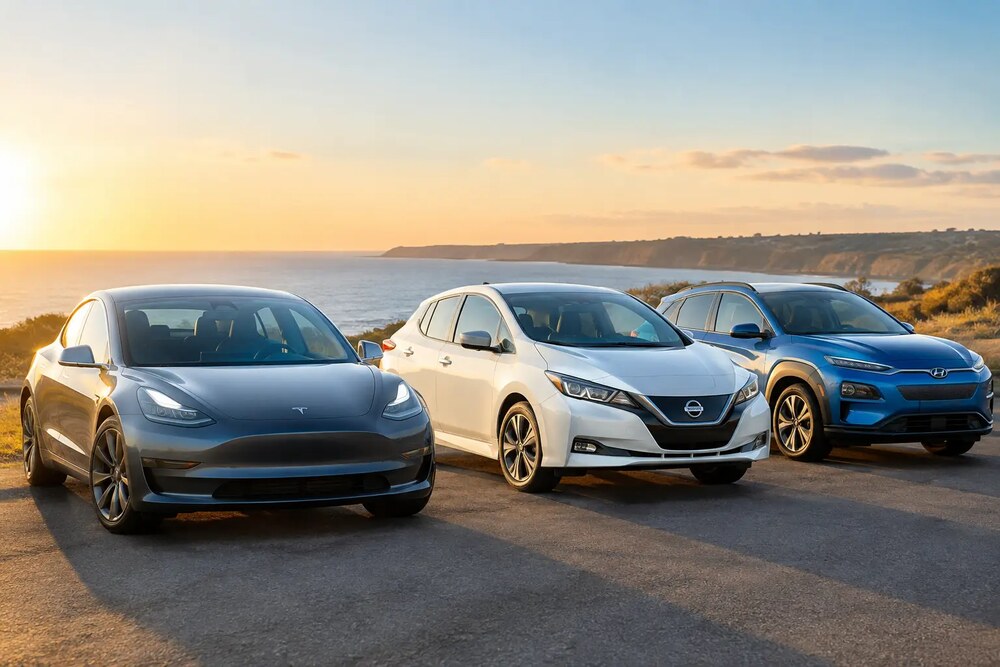
A used EV can make the weekday commute remarkably cheap to run, but the badge on the bonnet tells only part of the story. The best used electric cars for Australian buyers suit your daily kilometres, your charging access and your budget - not simply the model with the biggest claimed range.
Used EV choices have grown quickly, from compact city cars to long-range family SUVs. That gives buyers more value, but it also makes careful comparison essential. Battery condition, charging hardware, tyres, repair history and software features can affect ownership just as much as the purchase price.
10 best used electric cars in Australia
1. Tesla Model 3
The Tesla Model 3 is one of the easiest used EVs to recommend for buyers who want strong range, brisk performance and access to a well-established rapid-charging network. It is available in rear-wheel-drive, Long Range and Performance versions, so there is a broad spread of prices and capabilities in the used market.
Its practical four-door layout, generous boot space and efficient drivetrain make it suitable for commuting and longer road trips. The trade-off is that the minimalist cabin relies heavily on the central touchscreen, which will not suit every driver. Check for tyre wear, panel repairs, screen condition and whether features such as Enhanced Autopilot were included with the vehicle rather than assumed to transfer.
2. Hyundai Kona Electric
The Hyundai Kona Electric is a smart choice for buyers wanting SUV seating height without the size and energy use of a larger family SUV. Earlier 64kWh versions are particularly appealing because they offer genuinely useful real-world range, often enough for several days of metro driving or comfortable regional trips.
It is not the roomiest option in the back seat, and the boot is modest by SUV standards. Still, it is efficient, well equipped and supported by a familiar Australian dealer network. Confirm that any applicable recall work has been completed and compare the 39kWh and 64kWh battery versions carefully, as their range differs substantially.
3. MG ZS EV
For households moving from a petrol small SUV, the MG ZS EV is often one of the most approachable entry points. It has straightforward controls, five doors, useful rear-seat space and a conventional cabin layout. Used examples can represent strong value, especially for buyers who primarily charge at home and drive predictable daily routes.
Early models have less range than newer Long Range versions, so this is a car where the exact variant matters. A lower-priced Standard Range car can still be an excellent buy for school runs and commuting, but it may require more planning on interstate or frequent country trips.
4. Hyundai Ioniq Electric
The Hyundai Ioniq Electric has earned a reputation for impressive efficiency. Its aerodynamic hatchback shape and modest battery capacity mean it may not match the range of larger EVs, yet it uses electricity very sparingly. For an urban or suburban driver with home charging, that can be more valuable than a large battery.
The cabin is practical, and the hatchback body is easy to park. Earlier examples can be excellent value, although buyers should check their charging speed and connector type, particularly if rapid charging is central to their plans. It is best suited to drivers who value low running costs over SUV space.
5. Kia Niro EV
The Kia Niro EV is a sensible middle ground between a hatchback and a full-size SUV. It offers a comfortable ride, a usable boot and family-friendly rear seating, while its 64kWh battery provides reassuring range for regular travel beyond the city.
Its design is less dramatic than some newer EVs, which can be a positive for buyers who prefer conventional controls and visibility. It is usually priced above comparable small EVs, but the extra space and all-round capability can justify that difference. Inspect the service record and ensure both charging cables are included.
6. Nissan Leaf
The Nissan Leaf remains one of the most affordable ways into electric motoring. It is quiet, easy to drive and particularly well suited to short daily trips. Later 40kWh models offer more flexibility than the earliest cars, while the Leaf e+ adds further range for buyers who can find one within budget.
The key consideration is rapid charging. Many Leafs use the CHAdeMO connector rather than the CCS2 connector now common on newer EVs in Australia. That does not rule it out, especially for home-focused charging, but it can limit convenience on some routes. Check battery health information, charging history and local charger availability before committing.
7. BYD Atto 3
The BYD Atto 3 is a newer presence in the used market, but it is worth considering for buyers after a modern small SUV with good equipment and practical interior space. Its Blade Battery technology, rotating central screen and generous standard features have made it popular with first-time EV owners.
Because most examples are relatively new, used prices may sit close to new-car pricing. Compare the saving against the remaining factory warranty and any current new-car offers. If the gap is small, a near-new example needs to provide a clear benefit, such as lower upfront cost, accessories or immediate availability.
8. Polestar 2
The Polestar 2 suits buyers who want a more premium driving experience without moving to a traditional luxury SUV. It feels solid on the road, has a well-finished cabin and is available in single-motor and dual-motor forms. Long Range versions are especially capable for drivers who regularly travel between cities.
Its sloping rear design reduces rearward visibility compared with some SUVs, and rear-seat space is not class-leading. It is also worth checking specification closely, as wheel size, performance packs and optional equipment can affect ride comfort, tyre costs and resale appeal.
9. BMW i3
The BMW i3 is an unconventional but appealing used EV for city-based buyers. Its compact footprint, tight turning circle and light construction make it enjoyable around crowded streets and car parks. The distinctive interior still feels special, and later battery versions are more practical than the early models.
It is less suitable as a primary family car because of its compact rear seating and rear-hinged back doors. Tyres can be more specialised and costly than on mainstream hatchbacks, so include that in your running-cost calculations. A well-maintained i3 makes sense for buyers who prioritise urban driving character over outright range.
10. Jaguar I-PACE
The Jaguar I-PACE offers premium SUV comfort, strong performance and a distinctive alternative to the most common EV choices. It has a spacious cabin, confident road manners and enough range for many family road-trip needs. As used values have softened, it can look tempting beside newer mid-size EVs.
However, this is a vehicle to buy on condition rather than headline price. Insurance, tyres, servicing and potential repairs can cost more than for a mainstream EV. Seek a complete service history, inspect it carefully and consider an independent pre-purchase inspection before negotiating.
How to choose the best used electric car for your routine
Start with your real driving pattern. If you travel 30 to 60 kilometres most days and can charge overnight at home, a smaller-battery EV may be better value than a long-range model. If you frequently drive from Melbourne to regional Victoria, Sydney to the South Coast, or between major centres in Queensland, range and access to reliable rapid charging become much more important.
Then look beyond the advertised range figure. EV range changes with highway speed, hills, outside temperature, air conditioning, passenger load and wheel size. A seller's claimed real-world experience can be helpful, but it is not a substitute for checking the exact variant, battery capacity and independent range information.
Charging should be part of the buying decision from the beginning. Ask whether the car has a Type 2 charging cable, portable charging cable and any relevant adaptors. If you live in an apartment or rent your home, establish where you will regularly charge before buying. Public charging is improving, but relying on it for every charge can be less convenient and more expensive than home charging.
What to check before inspection and purchase
A used EV still needs the same careful checks as any used car. Review the odometer, service history, tyres, brakes, suspension, bodywork, interior condition and signs of accident repairs. EVs have fewer routine mechanical components than petrol cars, but they are not maintenance-free.
Ask for evidence of battery health where available, and check whether the remaining battery warranty applies to the vehicle. Confirm that the charging port operates correctly and, if practical, see the vehicle charge. Look for warning lights, test all screens and cameras, and make sure both keys are supplied.
Before finalising the deal, obtain a PPSR history report to check for finance owing, write-off history and other important records. A vehicle valuation can also help you understand whether the asking price reflects the model, age, kilometres and condition. On a trusted car marketplace such as Carface, detailed specifications, seller information and direct enquiries make it easier to compare like for like before you inspect.
The right used EV is the one that makes everyday driving simpler, not one that forces you to plan every trip around a charger. Take the time to compare the exact variant and its condition, then buy with confidence when the numbers, charging setup and vehicle history all line up.
