


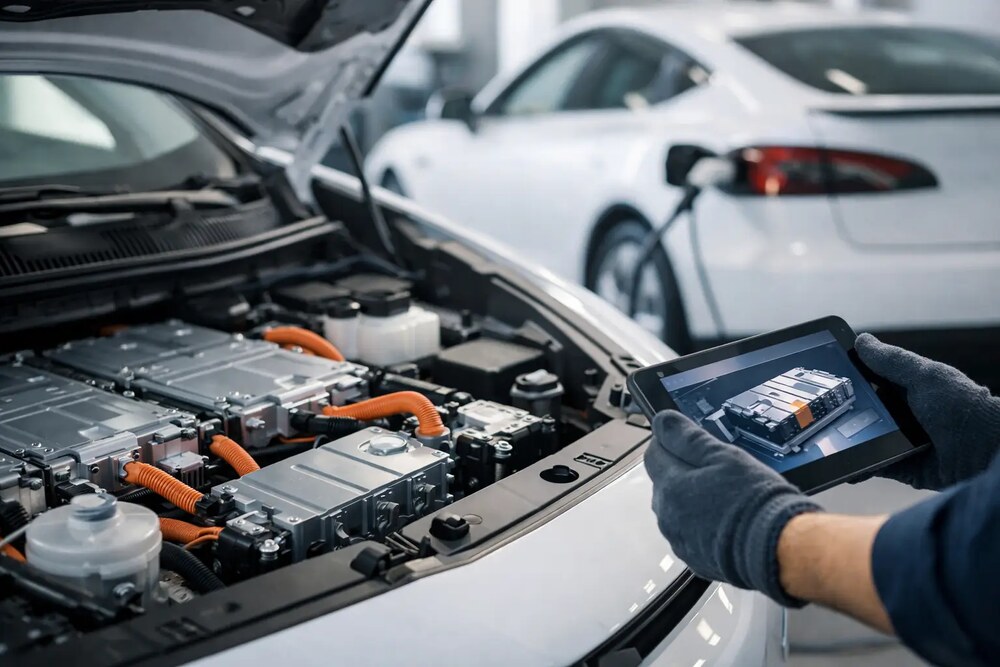
A used EV can look excellent on the driveway, with low kilometres and a clean interior, yet its long-term value may turn on one component you cannot see: the battery. Electric car battery health affects real-world range, charging performance, resale appeal and the cost of ownership. It deserves the same careful attention you would give a petrol car’s service history, tyres and mechanical inspection.
The good news is that EV batteries are designed to last for years, and most retain a large share of their original capacity. The key is not expecting a perfect battery. It is understanding its condition, comparing that condition fairly against the vehicle’s age and use, and checking the evidence before money changes hands.
What electric car battery health actually means
Battery health usually refers to how much usable energy the high-voltage battery can still store compared with when it was new. This is commonly described as state of health, or SOH. A battery with 90% state of health does not necessarily mean the car will travel exactly 90% of its advertised new range, because weather, speed, tyres, hills and air conditioning all influence range. It does mean there has been a measurable reduction in available battery capacity.
Some degradation is normal. Lithium-ion batteries age with time as well as kilometres, so a lightly driven seven-year-old EV may still show capacity loss. The rate varies considerably between models and owners. Battery chemistry, thermal management, climate, charging habits and whether the car has spent long periods sitting at a very high or very low charge all play a part.
Do not judge a used EV on the dashboard range figure alone. That estimate is based largely on recent driving, so it can look optimistic after slow suburban trips or conservative after motorway driving. A battery health report, a manufacturer diagnostic or detailed charging and service records give a clearer picture.
Why battery condition matters when buying a used EV
For many Australian buyers, range is the practical starting point. If your daily commute is 40 kilometres and you can charge at home, moderate battery degradation may make little difference to your routine. If you regularly drive between regional towns, tow a trailer or rely on public charging, the remaining range and charging behaviour deserve closer scrutiny.
Battery condition also affects value. Two otherwise identical EVs can justify different prices if one has a documented battery assessment, remaining factory warranty and consistent service history, while the other has no supporting information. A lower-priced EV is not automatically better value if its usable range no longer suits your needs.
There is also a distinction between battery capacity and battery faults. Gradual capacity loss is expected. Warning lights, restricted charging, sudden range changes, repeated overheating messages or a vehicle that will not accept normal charging may point to a fault that needs professional investigation. Treat these as inspection issues, not minor quirks.
Check the battery warranty first
Many EVs sold in Australia came with a separate high-voltage battery warranty, often around eight years and 160,000 kilometres, although terms differ by manufacturer, model year and vehicle. Some warranties set a minimum capacity threshold, while others cover manufacturing defects rather than general loss of range.
Ask for the original warranty booklet, service records and confirmation of the first registration date. Check whether the vehicle has been serviced according to the manufacturer’s requirements and whether any modifications could affect coverage. If the car is imported, confirm that warranty support and parts availability apply in Australia. Never assume a warranty transfers without reading the terms.
What affects EV battery life in Australia
Australian conditions can be demanding. Heat is one of the biggest factors in battery ageing, particularly when a vehicle is left fully charged for extended periods in hot weather. EVs with active liquid cooling generally manage battery temperature more effectively than older designs with simpler thermal control, but every model has its own strengths and limitations.
Fast charging is another area where context matters. Using DC fast chargers on road trips is normal and should not put you off a vehicle. Regular high-power charging, especially in very hot conditions or when the battery is already warm, can contribute to wear over time. It is one factor among many, not a reason to rule out every EV that has used public fast chargers.
Frequent charging to 100% is similar. Some manufacturers recommend a daily charging limit below full charge for certain battery types, while others provide different guidance. Charging to 100% before a long trip is sensible. Leaving a car at 100% for days during a heatwave is less ideal. Follow the advice specific to that model rather than applying one rule to every EV.
High kilometres are not automatically a concern either. An EV that has covered plenty of motorway kilometres, been regularly maintained and charged thoughtfully may be a stronger purchase than a low-kilometre car that has sat unused in harsh conditions. The evidence matters more than a single number on the odometer.
How to assess a used EV battery before you buy
Start by asking the seller direct questions. Has the vehicle had a battery health test or dealer diagnostic? Has it had any battery, charging or thermal-management repairs? What charging setup has it used most often? Has it been involved in a collision, flood or underbody impact? A transparent seller should be comfortable providing clear answers and supporting documents where available.
A professional pre-purchase inspection is worthwhile, particularly for an older EV or one priced well below comparable listings. Choose an inspector or workshop experienced with that make and capable of checking the high-voltage system safely. They may be able to scan for fault codes, assess charging operation, inspect the battery casing and cooling components, and identify signs of impact damage underneath the vehicle.
During an inspection and test drive, look for the basics as well as EV-specific details. Confirm that the car starts and drives normally, charges without errors and does not display warning messages. Check the charge port, cable condition and charge flap operation. Listen for unusual cooling-fan noise after driving or charging, and make sure the heating and air conditioning work properly, as they can significantly affect practical range.
If possible, drive a route that includes suburban and higher-speed roads. Watch for sudden drops in the battery percentage, a much lower than expected range estimate or power restrictions. These observations are not a substitute for a diagnostic report, but they can help identify questions to raise before proceeding.
Request the service history, any battery assessment and evidence of software updates. Software can improve charging management, range estimates and fault detection on some models. Also obtain a PPSR history report to check for finance owing, written-off status or theft records. A repaired write-off or substantial collision damage requires particular caution with an EV because battery packs sit low in the vehicle and can be costly to assess or replace.
A realistic view of battery replacement costs
Full battery replacement is the figure that often worries buyers, and it can be expensive. Costs vary widely by vehicle, battery size, parts supply and whether a new, remanufactured or repaired pack is appropriate. However, a complete replacement is not the likely outcome for every battery issue.
Some faults relate to a module, contactor, cooling part, sensor or charging component rather than the entire pack. Warranty coverage may apply where a fault meets the relevant terms. This is why accurate diagnosis matters. Avoid making a purchase decision based on alarming online estimates that may relate to a different model or an overseas repair market.
Instead, compare the asking price with similar vehicles, allow for the remaining battery warranty, and confirm whether the usable range suits your needs now rather than relying on a hypothetical future repair. For an older EV with limited range, a lower purchase price can still make sense as a second car or city commuter. It may not suit a buyer who needs frequent long-distance travel.
Selling an EV with confidence
If you are selling, battery information can reduce hesitation and help buyers compare your vehicle fairly. Gather the service records, original charging cables, warranty details and any battery health documentation before you list. Be clear about the real-world range you typically achieve, but explain the conditions, such as city commuting, motorway travel or use of air conditioning.
Photograph the charging cable, dashboard without warning lights, service history and any battery report you can share. State whether home charging equipment is included, but do not overstate the condition of the battery if you do not have a formal assessment. Clear facts build more trust than broad claims about a battery being perfect.
On a trusted car marketplace such as Carface, detailed specifications, vehicle history checks and direct buyer enquiries help both sides focus on the information that matters. A well-documented EV is easier for a buyer to inspect, value and purchase with confidence.
Battery health should be one part of a sensible used-EV decision, not a source of unnecessary fear. Match the car’s verified condition and remaining range to the driving you actually do, arrange the right inspection, and keep the records that support a fair deal.
