


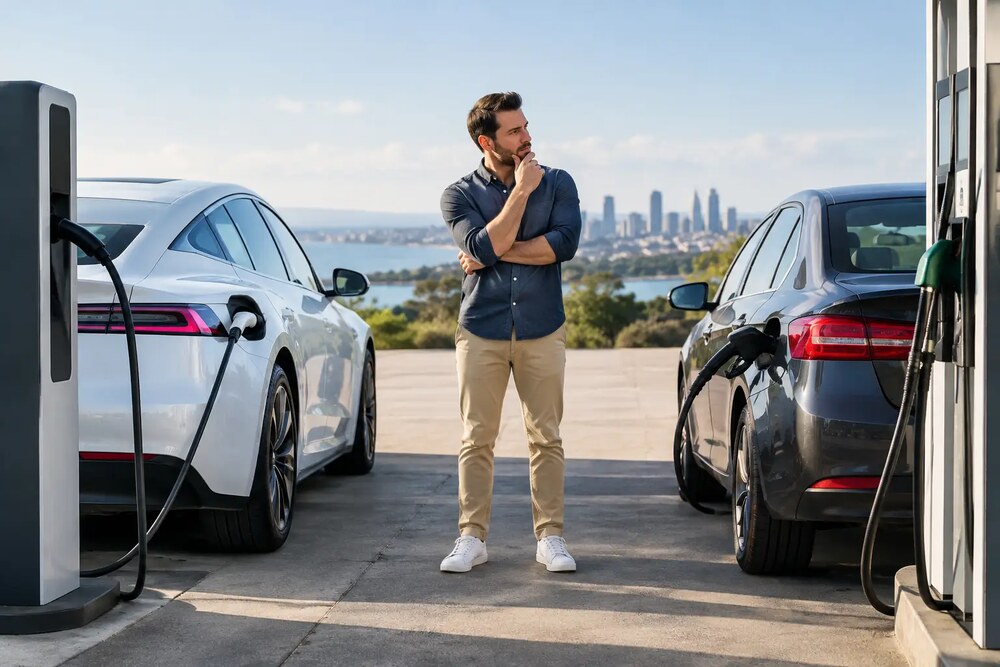
A $15 difference every time you fill up can feel minor until you multiply it across a year of school runs, commutes and weekend trips. That is why EV versus petrol running costs are worth comparing before you focus only on the advertised price. For many Australian drivers, an EV can be cheaper to run day to day, but the real saving depends on where you charge, how far you travel and the particular used vehicle you choose.
EV versus petrol running costs: the everyday difference
The biggest gap is usually between electricity and petrol. A typical electric vehicle uses roughly 15 to 20 kilowatt-hours (kWh) per 100 km. If you charge at home for 25 to 35 cents per kWh, that works out to about $3.75 to $7 per 100 km.
A comparable petrol car using 7 to 9 litres per 100 km costs around $12.60 to $19.80 per 100 km when unleaded is $1.80 to $2.20 per litre. Actual fuel prices move constantly, of course, but the direction is clear: home charging generally gives EV drivers a lower energy cost per kilometre.
For a driver covering 15,000 km each year, an EV charged mostly at home might use $560 to $1,050 in electricity. A petrol vehicle with typical consumption could use $1,890 to $2,970 in fuel. The annual difference can be meaningful, especially for commuters and families who regularly clock up kilometres.
There is an important qualification. An EV is not automatically cheap to charge if you rely heavily on public rapid chargers. Rates vary by provider, location and charger speed, and can be substantially higher than home electricity. Fast charging remains useful for road trips, apartment living and busy weeks, but it can reduce the running-cost advantage.
A simple cost comparison
Consider two used medium SUVs travelling 100 km. The petrol model returns 8.0 L/100 km and petrol costs $2.00 per litre, so the trip costs $16. The electric model uses 18 kWh/100 km. At a home charging rate of 30 cents per kWh, the same trip costs $5.40.
If that EV is charged at a public charger costing 60 cents per kWh, the trip instead costs $10.80. It is still less than the petrol example, but the margin is much smaller. This is why your charging plan matters as much as the vehicle’s official energy-consumption figure.
Charging at home changes the equation
Home charging is where EV ownership makes the most financial sense for many buyers. You can plug in overnight and start each day with useful range, rather than making a separate stop at a servo. Drivers with solar may reduce charging costs further when they can charge during daylight hours, although it is still sensible to consider the value of the electricity your solar system produces.
Before buying, check whether your parking arrangement supports charging. A house with off-street parking is straightforward in many cases, though you may need a dedicated wall charger and electrical work. An apartment, townhouse or rental property can be more complicated. Strata approval, shared parking and the distance from your switchboard all affect practicality and cost.
A portable charging cable can be convenient, but it charges more slowly than a properly installed wall unit. For some owners that is completely adequate. For households with high daily kilometres or more than one EV, a faster home setup may be worth the upfront expense.
Servicing: fewer moving parts, not no maintenance
Electric vehicles do not need engine oil, oil filters, spark plugs, timing belts or exhaust-system repairs. Regenerative braking can also reduce brake-pad wear, particularly in stop-start city driving. As a result, scheduled servicing is often less expensive than it is for an equivalent petrol vehicle.
That does not mean an EV is maintenance-free. It still needs tyres, brake-fluid checks, cabin filters, wheel alignments, wiper blades, suspension work and air-conditioning servicing. Like any used car, its condition and service history matter more than a broad promise of low maintenance.
Petrol vehicles have the advantage of a mature repair network and readily available expertise across Australia. A well-maintained petrol hatchback or SUV can be affordable to service, and independent mechanics can often handle routine work. However, as kilometres build, the engine, transmission, cooling and exhaust systems introduce more potential maintenance items.
When comparing listings, look beyond the next scheduled service. Ask for the service logbook or digital service records, check what work is due soon and factor that into your offer. A lower-priced vehicle needing tyres, brakes and a major service may not be the better value.
Tyres, insurance and registration still count
Energy and servicing are only part of the running-cost picture. EVs can be heavier than comparable petrol vehicles because of their battery packs. That weight, combined with instant torque, may contribute to tyre wear if the car is driven hard. Replacement tyres for some EVs, performance models and large SUVs can be expensive, so check tyre size and current tread depth during inspection.
Insurance premiums can vary sharply between vehicles. Some EVs cost more to insure because parts, specialist repairs and battery-related work can be expensive or less widely available. A petrol car with poor theft statistics, high performance or costly parts can be expensive too. Get insurance quotes using the exact make, model, year and suburb before committing, rather than assuming either fuel type will be cheaper.
Registration costs also depend on your state or territory and, in some places, vehicle weight or other classifications. State policies can change, so confirm the current cost for the individual vehicle. Government charges, stamp duty and registration are not always included in an advertised vehicle price, making it important to compare the full drive-away amount.
The used EV question: battery condition and warranty
The battery is the part of a used EV that attracts the most attention, and reasonably so. Battery capacity gradually declines with age, kilometres, charging habits and climate exposure. Most degradation is gradual rather than sudden, but reduced capacity can affect practical range and resale appeal.
Check the remaining battery warranty, including its kilometre and age limits. Many manufacturers cover the high-voltage battery for around eight years, often with a minimum capacity threshold, but terms differ. Confirm whether the warranty transfers to a new owner and whether all servicing requirements have been met.
Ask the seller about the vehicle’s real-world range, usual charging habits and any battery health reports available. A test drive is also useful for checking the displayed range, charge level and warning lights. For added confidence, arrange an independent inspection by a technician familiar with EVs where possible.
A battery replacement is a major potential expense, but it should not be treated as an inevitable bill for every used EV. The more practical approach is to assess the specific car’s age, warranty, range requirements and documented condition. A city commuter with reliable home charging may be comfortable with less range than a regional buyer who regularly drives long distances.
When petrol may still be the practical choice
Petrol can remain the right option for buyers without dependable charging, particularly if they drive long regional routes or tow regularly. Public charging coverage has improved across Australia, but access and reliability can vary away from major corridors. Towing also reduces an EV’s range, just as it increases fuel use in a petrol vehicle.
A budget-focused buyer may also find a lower-cost used petrol car that wins on total outlay, even if it costs more per kilometre. Purchase price, finance costs, depreciation and expected resale value are separate from running costs, but they all affect what the vehicle costs you overall.
For low-kilometre drivers, the annual fuel saving may be modest. Someone travelling 5,000 km a year will save less on energy than someone covering 25,000 km, so paying a large premium for an EV may take longer to make financial sense. The best choice is the one that suits your budget, driving pattern and charging access without stretching your finances.
Compare the whole vehicle, not just the fuel type
When searching for a used car, compare vehicles on the same practical terms: purchase price, kilometres, condition, service records, insurance, tyres, registration and likely energy costs. For EVs, add battery warranty, charging access and realistic range. For petrol cars, pay close attention to fuel economy, upcoming servicing and any signs of oil leaks, rough running or neglected maintenance.
Use the seller’s vehicle details to narrow your options, then inspect carefully and ask direct questions. A PPSR history report can help you check for financial encumbrances or a recorded write-off history, while a professional inspection can identify issues that photographs and a listing description cannot show.
The strongest choice is not necessarily the cheapest car to buy or the cheapest car to charge. It is the vehicle that fits your daily life, has a clear history and leaves you confident about the costs waiting after you drive it home.
