


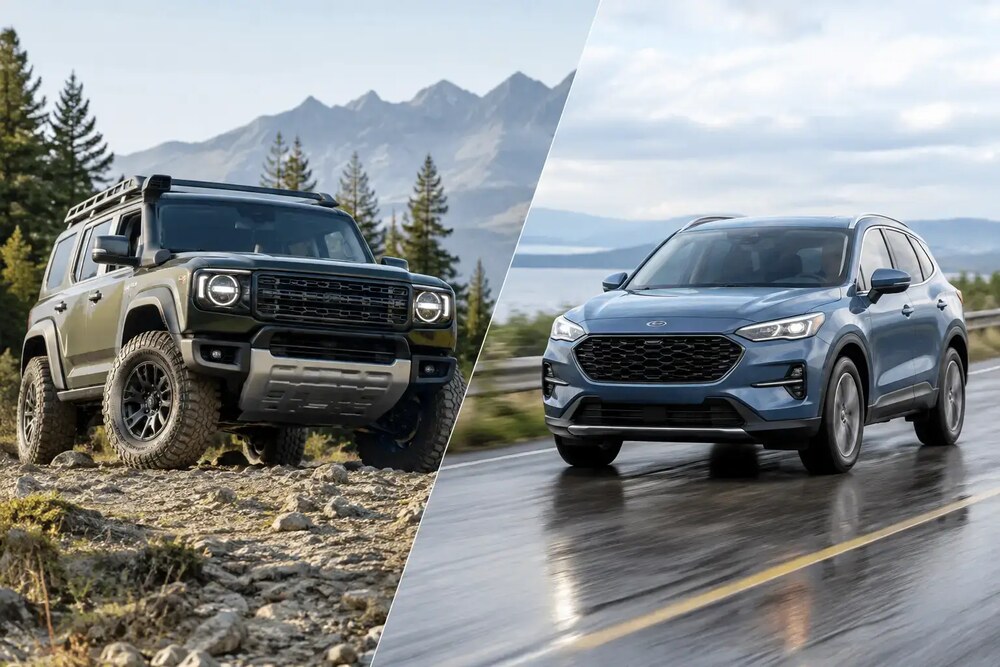
A wet suburban roundabout, a steep gravel driveway and a sandy beach access track can all test a vehicle’s traction differently. That is why the four wheel drive versus AWD question matters well beyond the badge on the tailgate. The right system can make daily driving more secure and a weekend escape more achievable. The wrong one can leave you paying for capability you rarely use - or without the features you need when the road ends.
For most used-car buyers, the answer comes down to where the vehicle will spend its time, what it needs to tow or carry, and how much off-road use is genuinely planned. Here is how to compare the systems with confidence.
Four wheel drive versus AWD: the key difference
Four wheel drive, often written as 4WD or 4x4, is designed primarily for difficult, low-grip terrain. In many traditional 4WDs, the driver selects two-wheel drive for normal sealed-road driving, then engages four-wheel drive when conditions demand it. Many also include low-range gearing, which provides controlled power at low speeds for situations such as climbing rocky tracks, descending steep hills, towing on loose ground or moving through deep sand.
All-wheel drive, or AWD, sends power to all four wheels automatically or continuously. It is usually engineered to improve grip and stability on sealed roads, wet surfaces and light unsealed roads. AWD systems use sensors and electronics to shift torque between the front and rear wheels, and sometimes from side to side, when traction changes.
The simple distinction is this: AWD is usually built around everyday road confidence, while a proper 4WD is built to keep moving when terrain becomes genuinely challenging. There are exceptions, so always check the exact vehicle specification rather than relying on the vehicle’s appearance or marketing description.
When AWD makes the most sense
AWD suits many Australian households because it adds confidence without asking the driver to understand transfer cases, locking differentials or low-range gearing. It is common in family SUVs, medium SUVs and some wagons, including popular models from Subaru, Mazda, Audi, BMW and Mercedes-Benz.
For school runs, motorway travel, wet weather and regional holidays, AWD can be an excellent fit. If one tyre begins to slip on a rain-soaked road or loose gravel, the system can direct power to wheels with better grip. That can make a vehicle feel more settled when pulling away, cornering or travelling on variable surfaces.
AWD is also often lighter and more refined than a traditional 4WD system. Depending on the model, that can mean better fuel economy, quieter road manners and easier parking in the city. It is a sensible option for buyers who occasionally visit campsites, ski fields or unsealed country roads but do not intend to tackle deep ruts, water crossings or remote tracks.
That said, AWD does not make a vehicle invincible. Ground clearance, tyre choice, approach angles and driver judgement still matter. A soft-roader with AWD may handle a muddy driveway well, but it can be damaged or stranded on terrain intended for a high-clearance 4WD.
When a four-wheel drive is worth it
A 4WD is generally the better choice when work, towing or travel regularly takes you beyond maintained roads. Utes and wagon-based 4WDs such as the Toyota LandCruiser, Ford Ranger, Isuzu MU-X and Mitsubishi Pajero Sport are popular with tradespeople, caravanners, rural drivers and buyers who want to explore Australia’s more demanding tracks.
Low range is the feature to look for. It multiplies torque while reducing speed, giving the driver more control over the vehicle. On a steep descent, low range can provide strong engine braking rather than forcing you to rely heavily on the brakes. In soft sand, it can help the vehicle move steadily without excessive wheelspin. For towing a caravan or boat on a slippery launch ramp, it can be especially useful.
Many 4WDs also offer stronger underbody protection, higher ground clearance and more serious towing credentials. These benefits are not automatic, though. Towing limits vary by model, variant, engine and towball download. Check the compliance plate, owner’s manual and the vehicle’s specifications before assuming a 4WD can legally tow the load you have in mind.
Traditional part-time 4WD systems should generally not be driven in four-wheel drive on dry bitumen unless the manufacturer specifically allows it. With no centre differential to accommodate different wheel speeds through corners, the drivetrain can bind up. This is a major reason to understand the system before a test drive.
Do not judge capability by the badge alone
The terms 4WD, AWD, 4x4 and SUV are frequently used loosely in used-car ads. Some vehicles have a selectable terrain mode but no low range. Others are full-time 4WDs with a centre differential, meaning they can operate in four-wheel drive on sealed roads. Some utes are two-wheel drive variants that look almost identical to their 4x4 counterparts.
When comparing listings, ask direct questions: does it have low range? Is it part-time or full-time four-wheel drive? Does it have a locking centre or rear differential? What tyres are fitted? Has it been used for towing or off-road travel?
These details matter more than a broad category. A well-maintained AWD with suitable tyres may be ideal for a family that stays on formed roads. A 4WD with worn all-terrain tyres, neglected servicing and poorly installed accessories may be a far less confident purchase, even if it has the capability you want on paper.
Consider the ownership costs, not just the purchase price
A 4WD can cost more to buy, fuel and maintain than an equivalent two-wheel-drive or AWD vehicle. Larger tyres, heavier components, higher servicing requirements and accessories such as bull bars, winches, roof racks and suspension lifts can all add to the ongoing budget.
AWD vehicles can also have specific maintenance needs. Tyres should be matched closely in size and wear because significant differences can place strain on some AWD drivetrains. Check the service history for transmission, differential and transfer-case fluid changes where applicable. If the vehicle has an electronic AWD system, make sure there are no warning lights and that its operation is covered during a proper inspection.
Insurance can vary as well, particularly where modifications are involved. If you are buying a modified 4WD, confirm the changes are legal, engineered where required and declared to the insurer. A lift kit, oversized tyres or added accessories may affect roadworthiness, safety and cover.
What to check on a used AWD or 4WD
A thorough inspection is worthwhile for any used vehicle, but driveline condition deserves extra attention here. During a test drive, listen for clunks, shudders, whining or vibration when accelerating, turning or changing between drive modes. On a safe, loose surface where permitted, check that selectable 4WD engages and disengages as intended. Do not force a lever or switch if you are unfamiliar with the system.
Look underneath for damage to bash plates, suspension arms, differential housings and the exhaust. Scratches are normal on a vehicle that has seen tracks, but hard impacts, leaks or bent components deserve professional assessment. Inspect tyres for uneven wear, including the spare, and check that all tyres match where the manufacturer requires it.
Ask for servicing records and clarify how the vehicle has been used. A well-documented 4WD that has toured regularly and been serviced on schedule can be a stronger buy than a lightly driven example with no history. Before money changes hands, arrange an independent mechanical inspection and review the vehicle’s PPSR history. These steps help you assess condition, finance owing and write-off history with clearer information.
Match the system to your real routine
Choose AWD if most kilometres are on sealed roads and you want added traction for rain, gravel and family trips. It offers a balanced, comfortable solution for plenty of Australian drivers.
Choose a genuine 4WD with low range if you tow regularly, work on unsealed sites, travel remote roads or plan to tackle beach driving and serious tracks. It asks more of your budget and your driving knowledge, but its extra capability can be valuable when conditions turn difficult.
When searching for your next vehicle, use the specifications, service history and seller information to compare like for like. A clear conversation with the seller, a careful inspection and a test drive that reflects your actual routine will tell you far more than a badge ever can. Buy the vehicle that makes your normal week easier and your planned weekends possible.
